
What crisis reveals about a startup
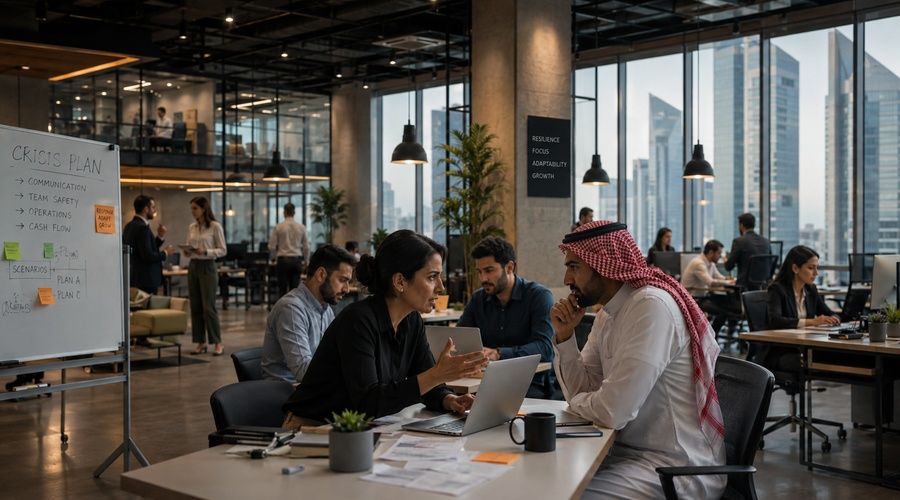
An article by Ayman Gomaa, Founder of Acacia Innovations Technology
When you are building a business, crisis planning is rarely a priority. Founders are focused on growth: winning customers, hiring talent, launching products and raising investment. Even in established organisations, preparing for disruption is often neglected until something goes wrong.
For founders across the Middle East and North Africa, however, disruption is hardly theoretical. Companies are building across markets exposed to geopolitical tensions, economic volatility, regulatory change and shifting access to capital, often while managing teams, customers and suppliers across several countries.
That makes resilience less of a corporate exercise and more of an operating capability. The businesses that emerge strongest from disruption are usually those that have prepared their people, systems and decision-making processes before they are tested.
Why leaders fail under pressure
It is deceptively simple to assume experience will carry you through a crisis. The problem is that most leadership skills are developed under normal conditions, not when time is compressed and the consequences of a poor decision are high. Leaders are often left to improvise precisely when improvisation becomes most dangerous.
According to PwC’s Global Crisis Survey, 95% of business leaders expect to face a crisis, yet nearly a third dedicate no staff to preparing for one. While 70% believe they would recover well from disruption, only around a third have the foundations of resilience in place. More than 40%, however, reported emerging from a crisis in a stronger position than before.
The difference is often preparation.
Not every disruption is a crisis
A crisis is an event that threatens something an organisation cannot afford to lose: its people, operations, reputation or customer trust. It also reduces the time available for making decisions and pushes the organisation beyond its normal ways of working.
A problem is something existing processes can absorb. A crisis exceeds them.
For startups, the most common forms include external disruptions such as geopolitical shocks, market downturns or regulatory changes; technology failures such as cyberattacks or data breaches; operational breakdowns involving suppliers, products or processes; and people crises, including the loss of a key leader, misconduct or burnout.
For MENA startups operating across multiple jurisdictions, these risks can overlap. A geopolitical event may disrupt a supply chain, affect customer demand and delay fundraising at the same time. A regulatory shift in one market can force a company to rethink how it operates or expands. A crisis rarely stays neatly within one function.
There are also levels. I think of it as a ladder: a disruption stresses the system, an incident breaks part of it, and a crisis threatens the whole. What moves you up that ladder is not simply the scale of the event but how quickly decision time disappears and how much you are forced to improvise.
Whatever the type, every crisis tests the same foundations: leadership, decision-making, trust, communication and adaptability.
During my 21 years in special operations, crisis was not an interruption to the job. It was the job. It taught me three things:
- You do not rise to the occasion; you fall to the level of your preparation.
- Trust is built before a crisis, not during it.
- The debrief is where the growth happens.
- The breach that does not announce itself.
The metaphor I use is that everyone sees the truck, but it is the snake that kills you.
The truck is the obvious attack, such as ransomware locking your screens. The snake is quieter: an employee’s credentials leak through a third-party breach and are later used by an attacker to log in with a valid password. There may be no obvious alarm because nothing appears to have been “hacked”.
In one case, leaked credentials were identified before they were used in an attack. The incident was initially treated as an IT problem. But the most important decisions were leadership decisions: whether to force a company-wide reset, how to communicate the issue and who would take responsibility for the response.
Technology may trigger the crisis. Leadership determines how the organisation will respond.
When gut-feeling trust goes wrong
In another case, a company had recently acquired a Mobile Virtual Network Operator and retained several employees from the previous business because management trusted them largely on instinct.
When a large volume of company data later appeared for sale online, the breach was initially assumed to be external. The investigation found it was an inside job, carried out not by those who had left but by one of the employees management had chosen to retain.
The lesson was not simply about cybersecurity. Trust cannot rely on instinct alone, particularly during acquisitions, rapid hiring or organisational change. It needs clear controls, accountability and systems behind it.
This is particularly relevant to startups expanding rapidly across the region, where teams can grow across different markets and operating cultures faster than internal governance develops. Technology may expose the problem, but the underlying weakness is often organisational.
Crisis planning does not have to be costly
Startups and SMEs do not need large budgets to prepare. They need better habits.
Create a one-page plan. Identify who decides, who communicates and who needs to be contacted for the three crises most likely to affect the business. A short plan people understand is more useful than a lengthy document nobody has read.
Run a 30-minute tabletop exercise every quarter. Pick a realistic scenario and ask what the team would do in the first hour. What happens if your biggest customer’s data leaks? If a payment provider goes offline? If regional disruption suddenly affects one of your key markets? Talking through the response once is better than assuming everyone will know what to do.
Build a debrief culture. After a lost deal, missed launch or difficult quarter, ask what the team learned rather than who failed. That habit builds the capacity to respond more effectively when the stakes are higher.
Startups also have an advantage. Larger organisations may have more resources, but founders often have fewer layers and can make decisions faster. In markets where conditions can change quickly, that can matter.
Their culture is also still taking shape, giving founders the opportunity to establish clearer communication, accountability and decision-making practices before they are seriously tested.
MENA founders already encounter smaller forms of disruption through fundraising gaps, regulatory changes, product setbacks, talent losses and interruptions in key markets. Each one provides a chance to assess how the organisation responds under pressure and where its weaknesses lie.
A crisis does not build the team. It reveals the team you built beforehand. Prepare your people, debrief honestly and treat smaller disruptions as rehearsals. In a region where uncertainty can quickly affect operating conditions, resilience is ultimately about maintaining sound judgement when the environment becomes less predictable.