
Arabic AI has a trust problem, not a language problem
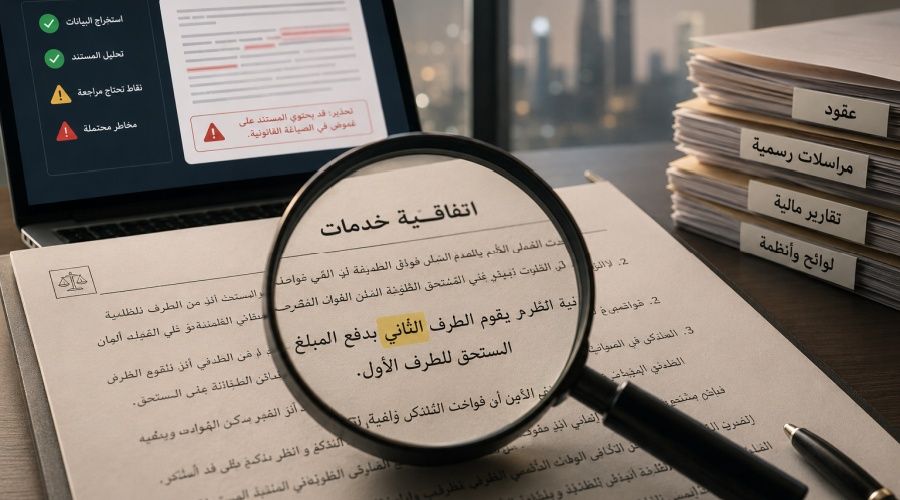
Why global AI models still struggle with Arabic.. and how region-specific technology is turning accuracy into a business advantage
An article by Mohammed Altassan, Founding CEO of OmniOps
The fluency illusion
Arabic is the language of governments, businesses, and institutions across the Gulf. It is the language of contracts, regulations, financial disclosures, and public services. As artificial intelligence adoption accelerates across the region — with Saudi Arabia alone committing $100 billion through Project Transcendence to become a top-15 AI nation by 2030 — many assume that the language challenge has largely been solved.
After all, today's leading AI models can produce Arabic that sounds fluent, natural, and convincing. But fluency is not the same as accuracy. In high-stakes environments such as banking, healthcare, legal services, and government operations, AI systems can still misunderstand the structural meaning of Arabic text while producing responses that appear entirely correct.
This is the new Arabic AI gap: models often sound right even when they are wrong.
In Arabic, a single diacritical mark can determine whether a noun is the subject or the object of a sentence. It can change who acquired a contract, who authorised a payment, or who bears legal liability. In most digital Arabic text, these marks are omitted entirely. Native speakers resolve such ambiguity through context. AI models frequently fail to do this.
An ALPS (Arabic Linguistic & Pragmatic Suite) study published in 2026 found that several frontier models performed exceptionally well at interpreting intent in Arabic while struggling with grammatical structures that often carry legal and operational significance. Researchers described this disconnect as a “syntax-pragmatics inversion” — a situation where the model understands what a sentence is broadly trying to communicate but misinterprets the mechanics who determine its precise meaning.
In casual conversation, that distinction may not matter. In a procurement contract, compliance document, regulatory filing, or Sharia-compliant financial agreement, it can materially alter the interpretation of a text.
The challenge is not that Arabic AI sounds unnatural. Quite the opposite. Today's models generate polished, coherent Arabic that often masks structural errors beneath the surface. The output appears trustworthy, making mistakes harder to detect and potentially more consequential.
Before AI can reason, it has to read
The challenge becomes even greater when organisations move beyond clean digital text and into the reality of enterprise data.
Across government, banking, healthcare, and legal sectors, institutions operate on decades of documents that were never designed for machine processing. Scanned contracts with degraded image quality. Handwritten forms. Legacy PDFs that combine Arabic and English within the same document. Financial records where numbers flow left-to-right within paragraphs that flow right-to-left.
General-purpose AI tools struggle to process this material consistently.
Arabic optical character recognition (OCR) remains a significant challenge at enterprise scale. Arabic script is inherently cursive, with letters changing shape depending on their position within a word. Add the absence of diacritics, regional terminology variations, and the routine mixing of Arabic and English in business environments, and the complexity quickly increases.
A 2025 academic roundtable organised by Harvard Law School's Program in Islamic Law found that OCR conversion of classical and formal Arabic documents often produces low accuracy and that digitisation alone does not make documents reliably machine-readable.
For many organisations, the AI model itself is not the main source of risk. The problem often begins earlier in the workflow.
If contracts, records, or forms are incorrectly digitised, even the most advanced model generates answers based on flawed inputs. The result is a dangerous illusion of accuracy: the AI appears confident because it has no awareness that the source material was misread in the first place.
This is where many Arabic AI deployments fail — and often do so silently. The system produces fluent responses because it has been trained to generate answers, not to recognise when the underlying data is unreliable. Errors then propagate into summaries, recommendations, decisions, and automated workflows.
Built to answer, not to know when to stop
Large language models are designed to produce outputs. When prompted, they generate responses confidently, fluently, and at length, regardless of whether the answer is correct.
A misinterpreted clause in a contract summary can be more dangerous than an obvious translation error because there are no visible warning signs prompting human review.
Research presented at the 2025 Arabic Natural Language Processing Conference found that factual hallucinations — fluent but fabricated outputs — were more common than faithfulness errors across the evaluated models. The issue has become significant enough that dedicated benchmarks and evaluation frameworks now exist specifically to measure hallucinations in Arabic and Islamic content.
The creation of IslamicEval 2025, the first shared task focused on detecting hallucinations in Islamic content, reflects growing recognition that these failures are no longer theoretical. Organisations are already encountering these issues in production environments.
For executives evaluating AI deployments, this development changes the conversation. The question is no longer whether a model can generate Arabic. Most modern models can.
The more important question is whether the system knows when it does not know.
In government, enterprise, legal, and regulatory environments, the correct response is not always an answer. Occasionally it is uncertainty, escalation, or a request for human review. Yet language models are inherently optimised to provide a response.
That behavioural gap must be engineered out through governance frameworks, prompt policies, human oversight, and deployment architectures that prioritise reliability over output volume.
The case for purpose-built Arabic AI
The ALPS benchmark revealed that purpose-built Arabic models outperformed some frontier models in areas such as presupposition and discourse analysis — tasks where the structural complexity of Arabic matters most.
This finding highlights an important reality: the path to reliable Arabic AI is not simply a matter of deploying larger models.
It requires deliberate architectural choices.
That includes training data that reflects real-world Arabic usage rather than translated English content. It requires OCR and document-processing systems designed specifically for Arabic document structures. It benefits from domain-specific models tuned for legal, regulatory, healthcare, or financial workflows. It also relies on guardrails that restrict the model's tendency to generate outputs beyond its verified scope of competence.
The organisations achieving the strongest results today are not necessarily using the largest models. They are building disciplined AI systems designed around clearly defined use cases.
That typically includes four elements:
Arabic-first document processing pipelines that can accurately digitise and structure enterprise data before it reaches the model.
Training datasets that reflect authentic Arabic usage across sectors and geographies.
Domain-specific deployments focused on clearly defined operational workflows.
Governance mechanisms and guardrails that reduce hallucinations and restrict overgeneration.
This approach often delivers higher accuracy while reducing computational overhead and operational risk.
Who owns the trust standard?
Saudi Arabia is making one of the world's most ambitious investments in artificial intelligence, spanning infrastructure, talent development, regulation, and adoption. The next challenge is to ensure that these systems can be trusted in Arabic, at scale, across both public and private institutions.
Technology stacks that combine advanced Arabic data processing, domain-specific governance, secure data management, and carefully selected local and international language models can address many of today's challenges. More importantly, they help organisations maintain oversight of outcomes and establish the operational discipline needed for long-term AI adoption.
Generative AI has largely solved the problem of producing fluent Arabic.
What remains unsolved is something far more important: trust.
In high-consequence environments, competitive advantage will not come from generating more words. It will come from knowing when those words can be relied upon.